


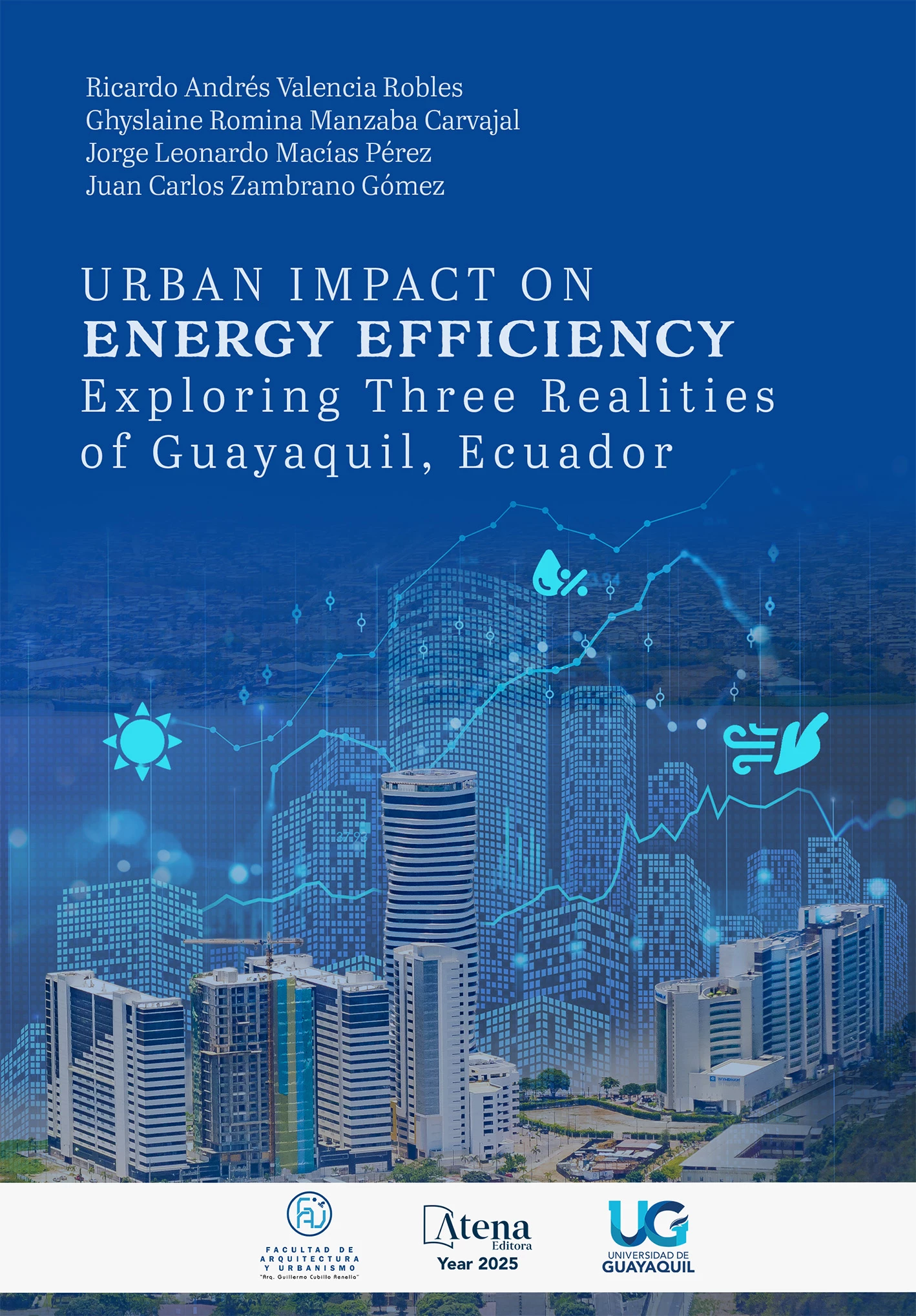
Urban Impact on Energy Efficiency: Exploring Three Realities of Guayaquil, Ecuador
This book emerges from a deep and growing concern regarding the intersection of urban development, energy efficiency, and climate justice in rapidly expanding tropical cities of the Global South. Guayaquil, Ecuador’s principal coastal metropolis, serves as a critical case study to examine these overlapping challenges. Situated in a humid tropical zone and characterized by diverse and often fragmented urban morphologies, Guayaquil encapsulates the broader patterns of Latin American urbanization—where informal settlements, spatial inequality, and climate vulnerability are intrinsically linked.
The research presented here is the result of sustained academic inquiry, interdisciplinary dialogue, and digital experimentation. It combines principles of urban and architectural design, morphological analysis, Building Information
Modeling (BIM), and environmental simulation to explore how three distinct urban sectors in Guayaquil—each shaped by different socio-economic trajectories—impact energy performance and thermal comfort. This study seeks not only to quantify urban energy behavior but to reflect critically on the policies and design strategies required to foster more equitable, efficient, and climate-responsive cities.
While aligned with international frameworks such as the Architecture 2030 Challenge and the Zero Code, this work approaches them through a Latin American lens—acknowledging that global standards must be locally interpreted and adapted.
In cities like Guayaquil, where informal urban growth predominates, and where climatic pressures intensify existing inequalities, energy-efficient design is not a technological luxury but a necessity for survival and dignity.
This book is offered as a contribution to the academic and professional communities engaged in sustainable urbanism, architectural innovation, and environmental equity. It is intended to support not only scholarly reflection but also informed decision-making by urban planners, architects, policymakers, and educators concerned with the future of tropical cities.
Special thanks are extended to the Faculty of Architecture and Urbanism at the University of Guayaquil, Ecuador, for their institutional support and academic collaboration throughout the development of this research.
Urban Impact on Energy Efficiency: Exploring Three Realities of Guayaquil, Ecuador
-
DOI: https://doi.org/10.22533/at.ed.437252110
-
ISBN: 978-65-258-3743-7
-
Palavras-chave: 1. Energy - Energy conservation and efficiency. I. Valencia Robles, Ricardo Andrés. II. Manzaba Carvajal, Ghyslaine Romina. III. Macías Pérez, Jorge Leonardo. IV. Title.
-
Ano: 2025
-
Número de páginas: 59
